Showing posts with label The. Show all posts

Monday, September 8, 2008

Athletics Day 1 Evening Session Review: Ups And Downs At The National Stadium


Diane Roy celebrates.


(BEIJING, September 8) -- Just like the morning session, the evening had 22 heats along with six finals which included the first track final of the Athletics competition. World and Paralympic records were set in the National Stadium and the Women's 5000m - T54 was marred by an accident.

Unfortunately for some participants of the Women's 5000m - T54 (wheelchair athletes with different levels of spinal cord injuries and amputations), a collision in the last lap, less than 100m from the finish line, caused six athletes to fall and abandon their race. The accident involved all three medalists from the Athens 2004 Paralympic Games, Wakako Tsuchida of Japan, Edith Hunkeler of Switzerland and Cheri Blauwet of the United States. Only five athletes finished the race and Diane Roy of Canada appeared to have taken the first Track gold medal in 11:54.03, setting a new Paralympic record. A close second was Shelly Woods of Great Britain with 11:54.29, while American Amanda McGrory came in third with 11:54.84. It was later announced that these results may not hold and the race is expected to be rescheduled on Tuesday.

Karim Betina of Algeria stole the show early in the Men's Shot Put - F32 (wheelchair athletes with different levels of cerebral palsy) when he broke the world record (9.92m) with just his second attempt (9.94m). It was just no stopping him after that as his throws kept improving and he landed the gold medal with a world record-breaking throw of 10.65m. Tunisia's Mourad Idoudi threw to a distance of 10.40m and picked up the silver, while third place went to Betina's teammate Mounir Bakiri with 9.37m.

China had to settle for fifth place in the Women's Long Jump - F42 (ambulant athletes with different levels of amputations and other disabilities including les autres) when Zhang Haiyuan, former world record holder, failed to repeat her winning performance of 2004 (Athens, Paralympics) and only managed a jump of 3.44m. Poland's Ewa Zielinska came in third with 3.62m, behind Annette Roozen of the Netherlands who secured the second spot with 3.63m. The gold medal went to Australian Christine Wolf who set a world record with her jump of 3.73m.

In the Men's Javelin - F35/36 (ambulant athletes with different levels of cerebral palsy), the clear favorite was China's Guo Wei. Cheered on by his home crowd, Guo Wei's first attempt at 54.92m broke his own world record in the F35 class and he did it again in his second throw with 56.07m which won him the top spot. Through the multi-classification event point system, Guo Wei was crowned gold medalist with 1283 points. In second place was Pawel Piotrowski of Poland who also got pass the old world record mark but his throw of 42.88m and 1158 point only earned him a Silver medal while Nicholas Newman of South Africa came in third with 42.48m and 1147 points.

Jackie Christiansen of Denmark won the gold and created a world record in the Men's Shot Put F44 (ambulant athletes with different levels of amputations and other disabilities including les autres). Christiansen blew away the competition with his throw of 17.89m and earned himself 1117 points. The second spot went to Australian Paul Raison with 15.83m and 988 points while Gerdan Fonseca of Cuba took bronze with 15.65m and 977 points.

Men's Discuss F33/34/52 (wheelchair athletes with different levels of cerebral palsy and different levels of spinal cord injuries and amputations) was the first final to begin and the last to end with a stellar display of strength and skill from all the athletes. In this multi-classification field event medals are awarded according to a point system. A new F52 world record (20.47m) ensured Aigars Apinis of Latvia the gold, with 1097 points. Chris Martin of Great Britain set the F33 Paralympic record with 28.37m (1074 points) and Roman Musil of the Czech Republic came in third with 27.11m (1026 points).


"Blade Runner" Oscar Pistorius competes at the Bird's Nest


Records were broken in some of the heats as well. In the Men's 100m - T11 heats, Lucas Prado of Brazil bettered his own world record of 11.26s when he sprinted to the finish line in a quick 11.19s, while Kurt Fearnley of Australia qualified for the finals of the Men's 5000m - T54 setting a Paralympic record of 10:13.21. South African Oscar Pistorius, better known as the "Blade Runner" also set a Paralympic record in the Men's 100m - T44 heats in 11.16s.

Wednesday, August 20, 2008

Chinese Lu Edges The Gold Medal At Men's Vault Final


Chinese Lu Edges The Gold Medal At Men's Vault


Gold medal winner Lu Bin at the awarding ceremony


(BEIJING, December 2) -- Lu Bin of China took the gold medal in the vault final with a total score of 16.525 points on Sunday evening at the Good Luck Beijing 2007 Gymnastics International Invitational Tournament.

Flavius Koczi of Romania earned the silver medal, and Makoto Okiguchi came in third.

Lu Bin won four gold medals in total at the gymnastics invitational for the pommel horse, still rings, vault, and men's team events.


Final action of Lu's landing


Top winners at the awarding ceremony


Bronze winner Japanese Makoto Okiguchi in action


Bronze winner Japanese Makoto Okiguchi in action


Bronze winner Japanese Makoto Okiguchi in action


Silver winner Flavius Koczi of Romania in action


Top gymnast in men's vault qualifications Chinese Liang Mingsheng fells down in final


Top three winners at the awarding ceremony


Chinese Lu Edges The Gold Medal At Men's Vault Final

Friday, August 8, 2008

Nobody Could Protest The Lego Olympics

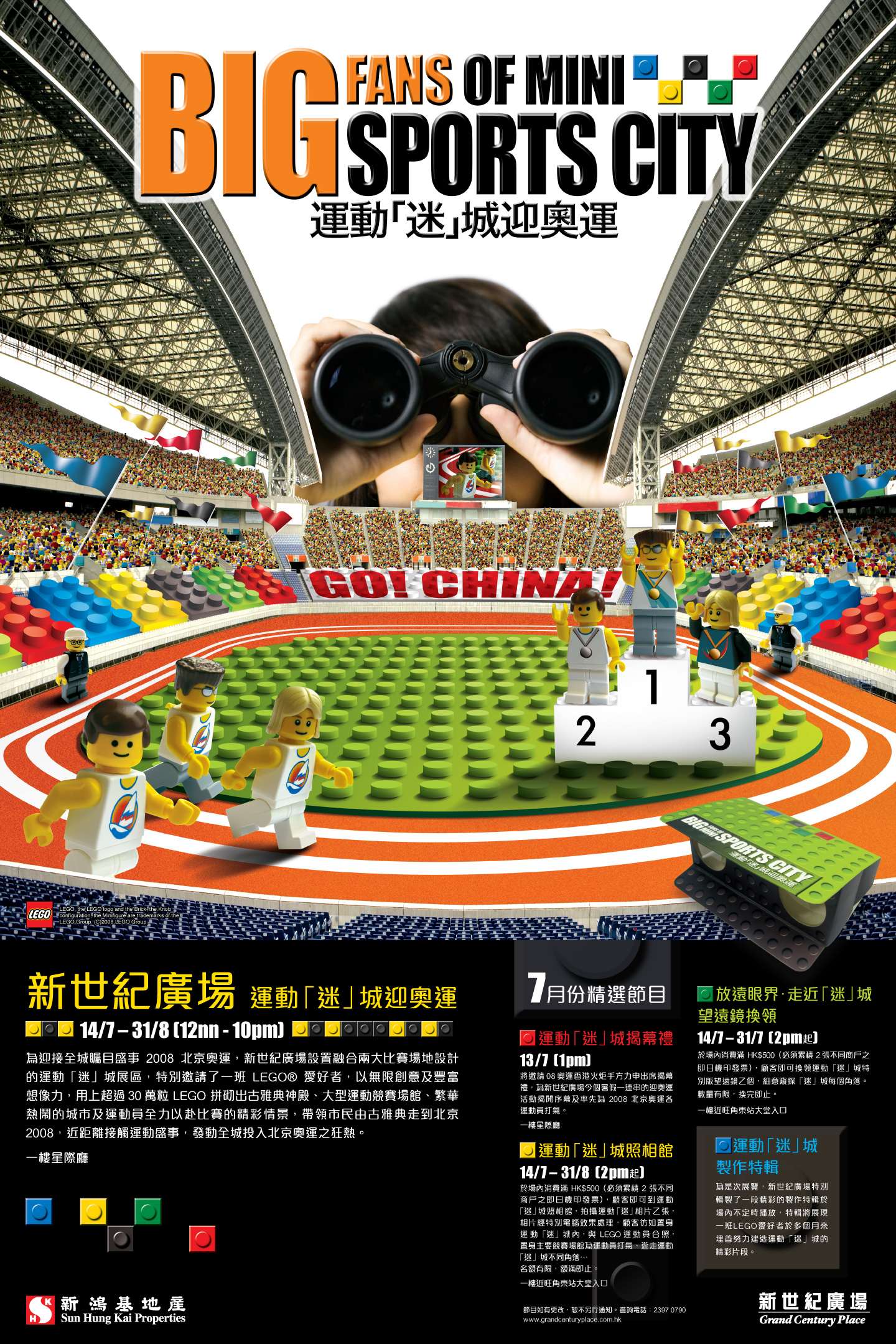
HKLUG Big Fans of Mini Sport City 2008

LEGO Sport City.
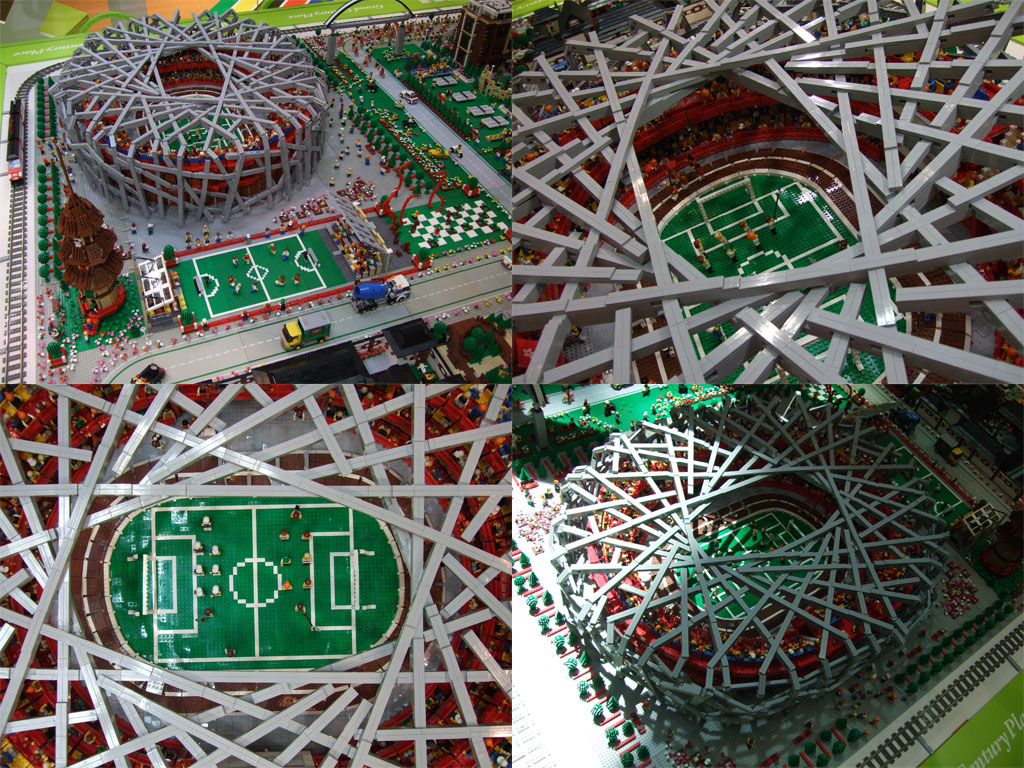
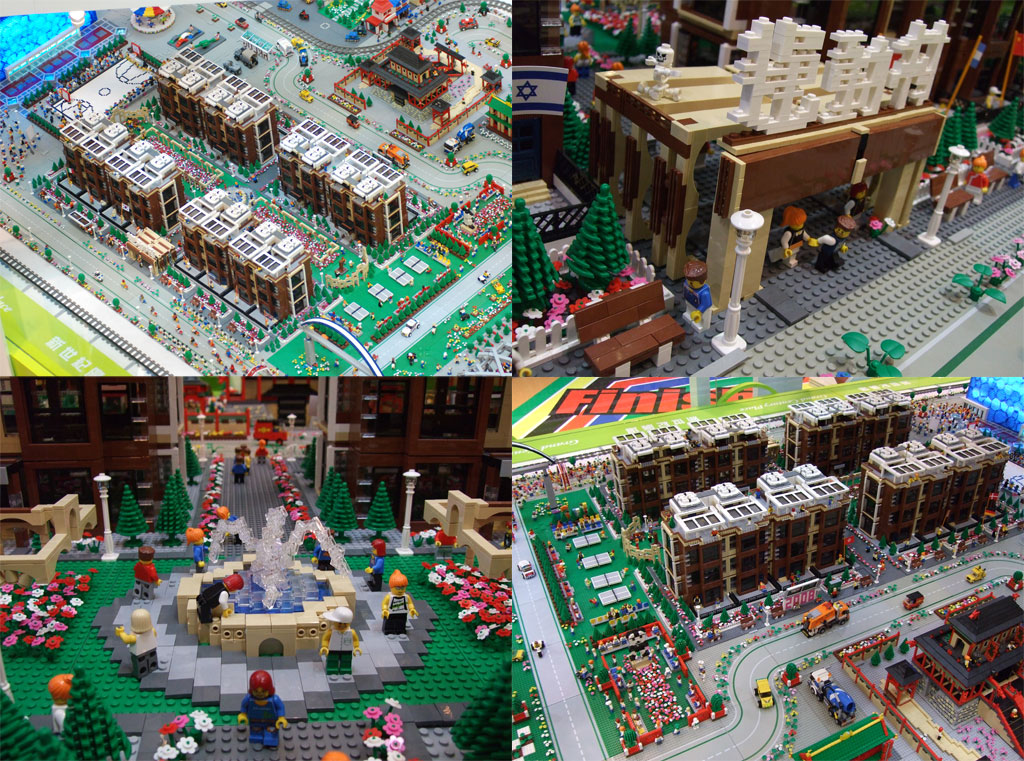
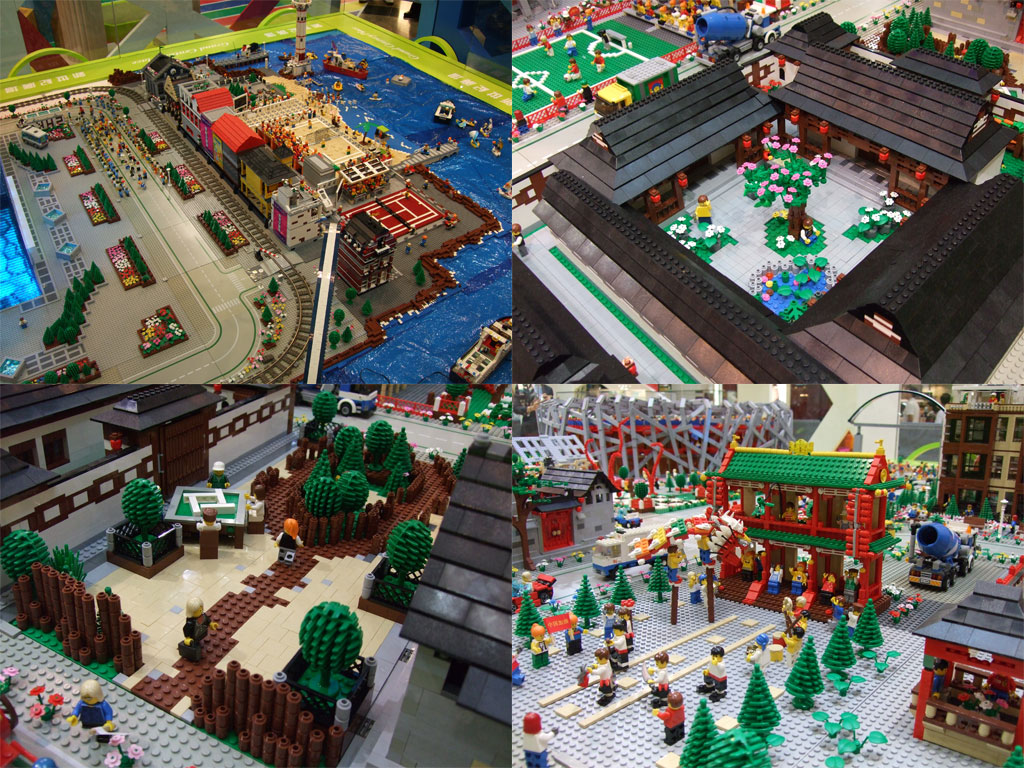
HKLUG presents LEGO Sport City. It is currently one of the most amazing LEGO productions ever in China. The theme of this city is the Beijing 2008 Olympic Games. Swimming Cube, Nest Sports Ground and Sport Village were built as a landmark of this LEGO city. 300,000 bricks and 4,500 mini-figures are used to construct a 3m x 8m artistic show. HKLUG would like to promote LEGO creative culture to local public as well as promote China to international by LEGO.

HKLUG – Hong Kong LEGO User Group
HKLUG was founded in 2007 with “Play Well; Play Pro” as the origin and the cornerstone for all its creativities promotions.

Supporting Casts
Coordinator: Hot
City Planner: Simon
Nest Sports Ground Designer: BreadMing
Swimming Cube Designer: Vincent
Sport Village Designer: ChiuKeung
Residence Building Designer: AndyBear
Equestrianism Designer: Hudson
Ancient Greek Designer: WaiKee
Helpers: Raymond, Kenny, Rex, Patrick, Mr. On, Mr. T, Boey, Hazel, SuperB, Vegeta, AntonyTam, BadLeo, DogJumpJump, Ivan, Schfio, Phantom, Habour, MingMing, Mic, AntonyLau, Queenie, Roni, Sabina, Rosanna, Iki, BoKingWan, Junnie, Yvonne, LHK

Nest Sports Ground

Swimming Cube

Sport Village

Residence Buildings

Equestrianism

Ancient Greek

Friday, August 1, 2008

Faking The Olympic Spirit In China's Muslim Region

Faking the Olympic Spirit in China's Muslim Region

The Olympic torch is in China's far West and security is tight. Still, there are some who came out to celebrate the event -- 200 invited guests and a handful of well-trained Uighar schoolchildren. Journalists were watched closely.

A gigantic statue of Mao waves to the people who have gathered in his shadow on Wednesday morning to celebrate the Olympic flame. But despite the size of the stone figure, there aren't many milling about on Kashgar's main square: Perhaps 200 invited guests -- 200 out of the region's 3.8 million residents. Ordinary citizens -- apart from groups of school children in festive costumes -- were not invited. The children wave banners and flags and shout "Go China." On the stage, the city's ensemble performs Uighur folk dances to music so loud it risks awakening Mao in his glass coffin in Beijing, thousands of kilometers east of here.

Officials in white shirts give stilted speeches, until the last runner finally arrives, an older man with a traditional Uighur hat -- called a dopa -- on his head. Speaking into a microphone, he says it is a great honor to hold the Olympic torch in his hands. He then punches it into the air. It is a gesture the master of ceremonies practiced with him next to the grandstand beforehand.

The Olympic flame, which the government has declared sacred, has arrived in the far West, where it will spend three days on its long journey through China's provinces. Kashgar is one of the country's outposts; it used to be an important caravansary on the Silk Road with a British and a Russian consulate. Today it is known for its big Sunday market, where farmers still trade camels and horses.


REPRINTS
Find out how you can reprint this SPIEGEL ONLINE article in your publication. In fact, the city is closer to Islamabad -- both culturally and geographically -- than to Beijing. Yet, just as the rest of China, it has undergone major changes in the last few years. Many of the old quarters with their mud houses and dark alleys have made way for broad streets and modern buildings.

Where once colorful market traders haggled near the famous Idkah Mosque, a sterile shopping center now stands. Donkey carts have become a rare sight in the city, whose residents weave around -- almost silently -- on battery-powered scooters.

In Kashgar the Han Chinese are a minority. In some quarters, they show their faces only very rarely. Some of them fear the Uighurs, with their European facial features and their women who hide their entire faces under brown cloth. Others pull their veils only over their noses. Most, however, only wear a headscarf.
'Be Disciplined and Obey the Law'

In Kashgar men wearing dopas make copper caldrons and tin boxes in their workshops, sell honey and watermelons, gossip in tea houses and pray in the numerous small mosques.

The voices of the muezzins, however, can hardly be heard in the street during the day, as the Chinese authorities have banned them from using loudspeakers. And anyone under 18 years is not allowed to worship Allah in one of the mosques.

Many older Uighars hardly understand Chinese. Yet, many young people also have no grasp of the official language. Written in Arabic and Chinese on a mud wall in an alleyway is: "Be a good citizen, be disciplined and obey the law."

"What I think of the torch relay?" a merchant in a teahouse asks. "Not much, as they are forcing all shops to close for two days. That means no revenue."

In fact, many traders in the city center had to pull down their shutters a day before the Olympic flame arrived in Kashgar, creating a leaden atmosphere in the usually bustling streets.

On the day of the torch run, only invited guests from selected "work units" and schools were allowed to cheer on the runners from the roadside. The homes around the Idkah Mosque and the people's square seemed deserted: No windows were open and no residents watched the spectacle from above. Meanwhile, soldiers, militia and police gathered in large numbers and hermetically sealed off the area around the mosque. They even stuck yellow tape over the storm drains.

The Chinese government is wary of its remote province, in particular of Kashgar. As in Tibet, Beijing sniffs a conspiracy in the autonomous Muslim region of Xinjiang -- not by the "traitorous Dalai Lama clique," but the Uighar separatists who are fighting for an independent East Turkistan.

Yet, how dangerous these groups are is unclear. Uighars in exile accuse Beijing of exaggerating the danger, to give it a reason to clamp down on religious groups.

The Chinese media, however, again and again reports attacks and conspiracies by Uighar terrorists. Recently staff of China Southern airline discovered a female passenger who tried to use gasoline to set a plane on fire. The government said it was a terrorist act, but so far it has failed to offer any proof of the real motives behind the attack.
'More Cheering'
The fear, though, is great, and it overshadows the Kashgar stage of the torch run. There is no sign of the festive atmosphere that attended the first stage of the torch relay in China, on the tropical island of Hainan. In Kashgar nobody seems happy, though the image on television later will no doubt be a different one.

Everything has been rehearsed: "More cheering," a regional television camera man tells a group of young people, who are not waving their Olympic flags enthusiastically enough for him.

Even here, far away from world public opinion, the Beijing Communist Party manages to instrumentalize the Olympic torch: to show a demonstration of unity between the party and the -- non-existing -- people, and a unified China.

"Write a beautiful chapter of harmony and progress -- paint a magnificent painting of scientific progress," the inscriptions of banners along the route read, "Welcome the Olympic Games with all your heart."

Tight Controls on Journalists

The few foreign journalists who have made the long journey into the desert are strangely referred to as "liberators" in their registration forms. Yet despite the moniker, they have not been liberated to watch the spectacle as they might have liked.

The authorities decided who was allowed to go to Kashgar. For "security reasons" they all have to stay at the shabby Qinibagh Hotel. Other hotels were instructed to turn away foreign journalists. Young helpers handed the journalists a comprehensive brochure, which mainly contains prohibitions and urges them "to show courtesy."

The authorities have forbidden journalists to watch the torch relay from the roadside. The foreign press are only allowed to be at the start and finish, where they are first carefully searched and then closely monitored by officials.

The Olympics in China's Wild West is no relaxed affair. Kashgar has been cowed and the Communist Party, with its security phobia, has the city totally in its grip. One wonders what the actual games in Beijing might look like. The answer comes blaring out of the loudspeakers under the Mao statue: "We are ready!"

By Andreas Lorenz